You know that piece in your closet you keep brushing past?
Maybe you bought it because you were SO excited about it. Maybe it was on sale. Maybe it “fit,” in the sense that you could get it on your body. Or maybe you just needed something and it was right there.
Either way, there it hangs, while you wear the same handful of things on repeat.
And the confusing part is that it’s not a bad piece! So why isn’t it getting worn?
Most times, it comes down to what we consider when we’re shopping.
We buy things because they’re cute, they’re on sale, or they technically fit. But we don’t always stop to think about whether they’re actually right for us, or we don’t know what to look for in the first place.
So we end up with almost-right pieces.
They’re clothes we like, but something about them doesn’t quite work for us. Maybe they don’t serve our everyday lives, don’t feel like us, or don’t fit quite right. So we keep passing them over for something else.
The problem isn’t necessarily that we’re buying bad clothes. We’re buying clothes that aren’t quite right for us.
So how do you stop buying clothes you never wear?
The key is to look beyond whether you like something and consider whether you’ll actually enjoy wearing it.
There are four things I recommend checking before you buy, so you choose pieces you’ll not only love, but love to WEAR. I call this the 4 Fits Test.
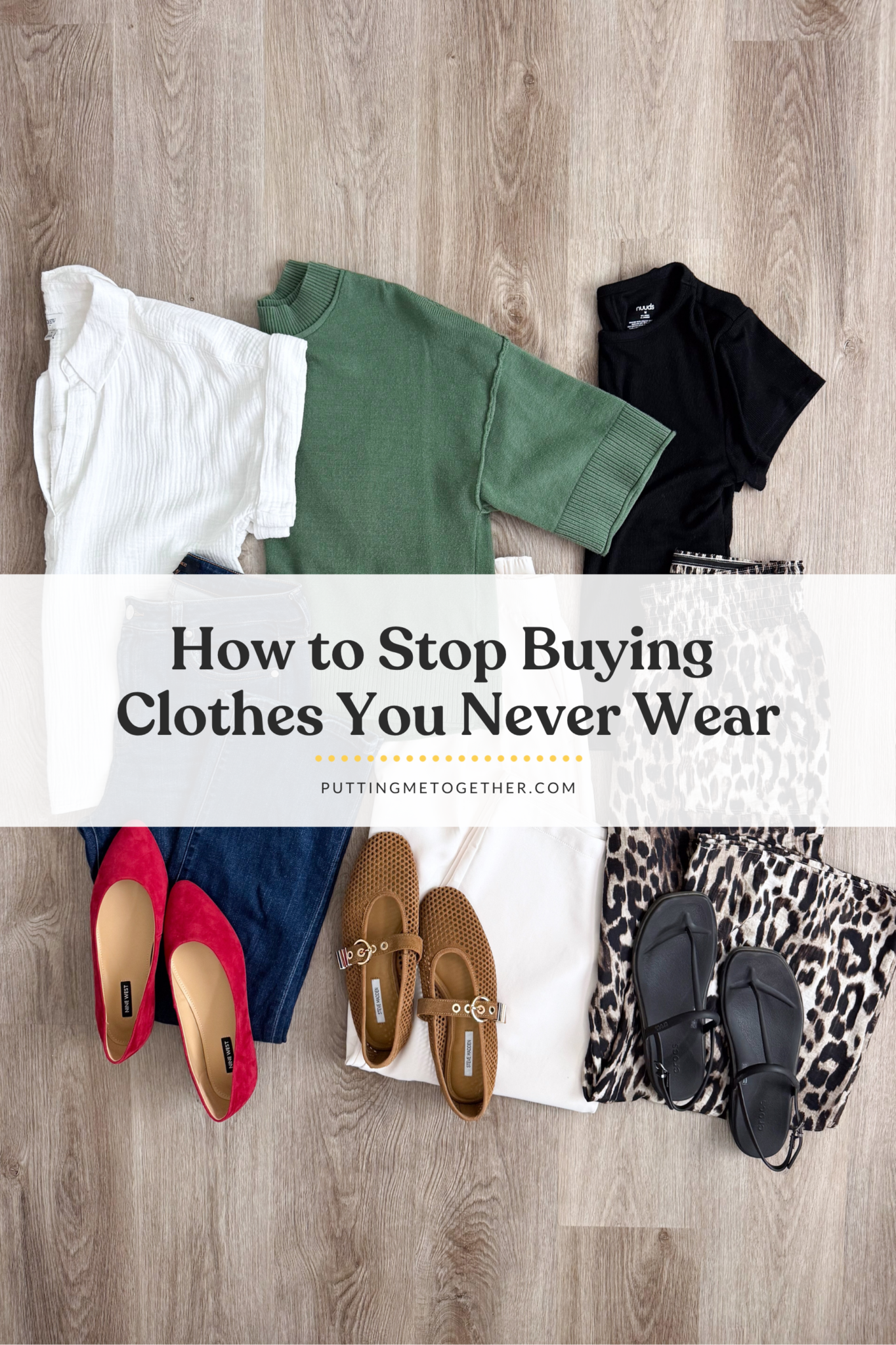
The 4 Fits Test: How to Buy Clothes You’ll Actually Wear
When you’re considering a new piece of clothing, think about how it fits in four areas.
1. Lifestyle Fit: Does It Work for the Life You Actually Live?
The first thing to consider is whether a piece of clothing actually serves your lifestyle.
Maybe you love pretty blouses or cute shoes, but most of your days involve working from home, running errands, or a casual work environment.
There’s nothing wrong with loving those clothes! But if you rarely have an occasion to wear them, they’re likely to sit in your closet.
And if your closet is FULL of them, you’ll end up with a bunch of beautiful clothes but still feel like you have nothing to wear on a regular Tuesday.
Don’t build a wardrobe for a life you don’t have.
So before you buy, get clear on what your days really require, not just what kinds of clothes catch your eye.
Maybe for you that means no a long pause on buying blouses, but also not throwing in the towel just because your lifestyle is now super casual. It means learning to do casual style really well.
I had to make this transition myself about 8 to 10 years ago. And now? I have graphic tees, really awesome jeans and casual pants, and fun sneakers that DELIGHT me! I wear them all the time, and they make me feel super cool. 😎
The question to ask: Does this piece serve the life I actually live?
You can absolutely buy clothes for special occasions! Just make sure your wardrobe has enough pieces to support the things you do most often.
2. Personal Style Fit: Does It Feel Like You?
The second thing to consider is whether a piece fits your personal style.
How many times have you bought something because it looked SO good on someone else, only to realize it doesn’t feel right on you?
And the frustrating part is that you often can’t say why. It looks fine. It might even look good on you. It just doesn’t feel like YOU.
And when a piece doesn’t fit your style, it hangs there while you keep reaching past it for the things that do.
I’ve done this too, especially when I was much younger and couldn’t put words to my style. I had an intuitive sense of it, but it wasn’t until I studied different style archetypes (and taught them to others as a style coach) that I could really sharpen my shopping choices and avoid pieces I knew I wouldn’t wear.
Part of the trap is that when you see a piece on someone else, you’re not just seeing the piece. You’re seeing her styling, her confidence, and how it fits her life and her style. That’s a lot of context you don’t get to take home with you.
It’s the shift I see in our Simply Put Together students and Style Club members once they learn their unique Style Type Mixes. They look at a piece and say, “That looks so so great on her, but I know I wouldn’t wear it. It’s too romantic for my style,” or “It’s too classic for my taste.” It’s SO powerful! You become such a better shopper (and save way more money on pieces you’d never wear) the more you are able to articulate your style.
The question to ask: Does this piece fit MY style, or do I mostly love how it looks on someone else?
The goal isn’t a closet full of clothes that look good on other people. It’s a closet full of clothes YOU feel good wearing.
3. Body Fit: Does It Fit Your Body Properly?
The third thing to consider is whether a piece fits your body.
You can find a piece that fits your life and your style, but if it doesn’t fit your body well, you still might not wear it. And body fit happens in two ways.
First, the Clothes Need to Fit Properly
As Stacy London and Clinton Kelly of What Not to Wear famously said: “If you don’t have fit, you don’t have style.”
You could wear the exact same outfit as someone else. The same pieces, a total copy of her super cute look. But if those pieces don’t fit you well, it’s going to look frumpy on you.
And when clothes bunch, hang awkwardly, or pull in weird ways, you feel frumpy in them. So you never want to wear them.
If you want a quick guideline on what proper fit looks like, I walk through it in Wardrobe From Scratch, Part 3: Basic Guide to Proper Fit.
Second, the Cut Needs to Work for Your Body
Sometimes choosing a different size solves the problem, yes. But not always.
Have you ever tried on pants where one size was too tight, but the next size up was too big?
Sometimes the problem isn’t the size. It’s the cut.
Even in your correct size, the cut and shape of a piece might not be the best shape for your figure. Two pairs of jeans in the same size can fit completely differently because of their rise, shape, and proportions. The same goes for tops. One blouse might follow your curves and figure beautifully, while another pulls or bunches in all the wrong places.
Not every cut is going to work for every body, even when you’re wearing the correct size.
And that’s okay! You don’t need to force yourself into a cut that doesn’t work for you.
If clothes don’t fit your body well, the problem isn’t your body. You may simply need a different cut.
This is where knowing how to dress your shape comes in.
Two women can wear the exact same size and need completely different cuts. Every body has different proportions, and every piece of clothing has different fit points: where it hits, where it skims, where it has room, where it pulls.
When you know your shape and which fit points your clothes need so they work for you, you’re not guessing anymore. You can choose pieces that actually work for you — the ones that look good and make you feel confident.
Without that, you end up with almost-right pieces. They technically fit, but something about them doesn’t quite work on your body. So they hang in your closet while you reach for the things that do.
It’s not about hiding anything or following rules. It’s about knowing exactly how your clothes need to work on your body so you can choose clothes that you feel really confident in.
For example, wide leg jeans can look amazing or awkward depending on the cut. On ANY shape. Whether you’re petite, tall, pear shaped, rectangle shaped hourglass shaped. We’ve helped women of almost ALL sizes, heights, and body shapes feel good in wide leg jeans. Women who said, “I’m too short to pull off wide leg jeans,” and “They don’t work with my pear shape.” They end up realizing it’s all in fit points of the various cuts. But it’s a matter of understanding the nuanced fit points YOUR shape needs.
(BTW, on that note, I share four basic fit tips for finding the right pair in How to Look Good in Wide Leg Jeans. It doesn’t go into all the details for your body type and height, but it does get you started on a good path.)
The question to ask: Does this piece fit my body well, or am I trying to make a cut work that isn’t right for me?
4. Wardrobe Fit: Does It Fit Into the Wardrobe You’re Building?
The fourth thing to consider is whether a piece fits your wardrobe, whether that’s the one you have now or the one you’re building.
How many times have you bought something cute, only to get it home and realize you have nothing to wear it with?
A piece can fit your life, your style, and your body and still never get worn if you can’t make outfits with it. That’s another way you end up with almost-right pieces.
It’s also a big part of that “closet full of clothes but nothing to wear” feeling. Lots of individual pieces, but nothing that works together.
Having a good plan for a well-built wardrobe will help that. A well-built wardrobe has a good balance of glue pieces and flair pieces. For more on this, see my oldie but goodie Foundations and Flair: My Philosophy for Crafting a Wardrobe. Again, it doesn’t get into the details or specifics, but it does start you off with a good framework.
If you want a wardrobe that works, you need pieces that work together, not just individual items you like.
The question to ask: Does this piece have a place in the wardrobe I’m building?
Almost-Right Pieces vs. Just-Right Pieces
So if you’ve ever wondered why you have a closet full of clothes but nothing to wear, here’s why: your closet is full of almost-right pieces, and what you need are just-right pieces.
Here’s how I think about it. My daughters have just-right books at school. They’re the books that are just right for each of their reading levels.
A book can be a great book and still not be the right book for them. Clothes work the same way. A piece can be cute, on sale, even a really good piece, and still not be just right for YOU.
Just-right pieces fit all four: your life, your style, your body, and your wardrobe. Those are the ones you reach for again and again. They serve your life, they fit your style and make you feel like your best self, they fit your shape in a way that makes you feel confident, and you can actually use them in your wardrobe. OF COURSE you’ll want to wear them!
Almost-right pieces check SOME of the boxes but miss on at least one. And one miss is enough to keep it hanging in your closet.
It might fit your body perfectly and work with everything you own, but not feel like your style. Or it might feel totally like you and fit beautifully, but have no place in your everyday life.
So the next time you find something you’re tempted to buy, run it through the 4 Fits Test:
- Lifestyle Fit: Does it serve the life I actually live?
- Personal Style Fit: Is it aligned with MY style, not someone else’s?
- Body Fit: Does it fit my body well?
- Wardrobe Fit: Does it have a place in the wardrobe I’m building?
If it’s a yes on all four, you’ve found a just-right piece. Bring it home!
If it’s a no on even one, you can say, “That’s cute, but it’s an almost-right piece. I’m looking for a just-right piece.” And leave it at the store.
Of course, even a just-right piece might need a little help with styling. But you’ll be starting with something that has a MUCH better chance of being worn.
Because the goal isn’t just to buy clothes you love. It’s to buy clothes you’ll love WEARING.
Want More Help Finding Just-Right Pieces?
If you’d like help finding just-right pieces for YOUR life, YOUR style, YOUR body, and YOUR wardrobe, I’d love to have you join us in the Style Club. And if you’ve got almost-right pieces hanging in your closet, we’ll help you find ways to wear those, too. 😊
The doors are closed right now, but you can join the waitlist to be the first to know when they open. Join the waitlist HERE.